
Is it time for an Investment Property Performance Review of your Charleston investment property?

An Investment Property Performance Review helps you look at your property’s current value, rental income, expenses, equity position, tax exposure, ownership goals, and future repositioning options. The Asset Performance Test is one important part of that larger review, helping determine whether the property itself is still performing well enough to hold, improve, sell, exchange, or reposition.
Introduction
An Investment Property Performance Review is especially valuable for Charleston SC property owners who have held real estate for many years and are now wondering whether their property still fits their goals.
Many local investors, especially those 50 and older, have seen their property values rise significantly. However, higher value does not always mean stronger performance. Rents may not have kept pace with appreciation. At the same time, property taxes, insurance, HOA fees, maintenance, contractor costs, and major repair expenses have continued to rise.
That creates an important question:
Is your property still helping you build, protect, and pass on wealth, or is it becoming harder to justify?
At Byrd Property Group, our Investment Property Performance Review brings these issues together in one organized conversation.
What Is an Investment Property Performance Review?
An Investment Property Performance Review is a practical way to evaluate how well a real estate asset is performing compared to its current market value, income, expenses, risks, and your personal goals.
At Byrd Property Group, we use the Investment Property Performance Review as a big-picture planning conversation for investment property owners. The Asset Performance Test is one important part of the review, but it is not the entire process.
The full review looks beyond value and rent. It connects the property to the owner’s financial plan, tax picture, estate plan, family situation, retirement goals, income needs, and possible repositioning strategies.
The Investment Property Performance Review is not just a home valuation or a rental estimate and it’s not just a quick opinion of value.
It looks at the bigger picture.
A comprehensive Investment Property Performance Review may include:
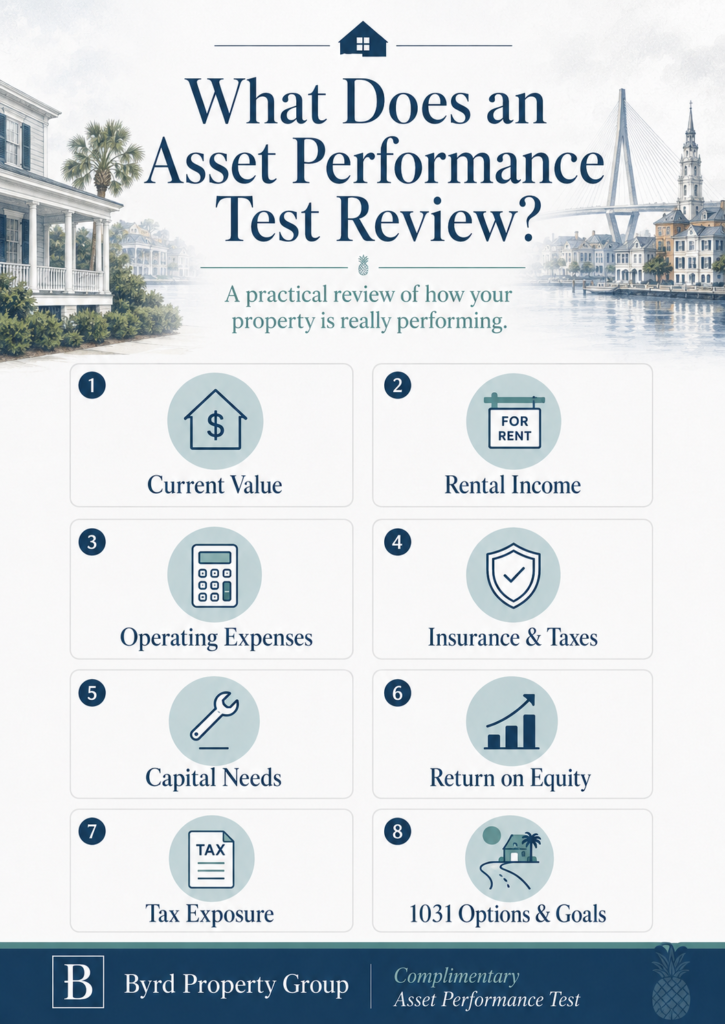
- Current Market Analysis / Property Valuation
- Rental Property Income Analysis
- Operating expense review
- Net operating income review
- Cash-on-cash return analysis
- Asset Performance Test
- Return on equity review
- Deferred maintenance and capital improvement review
- Capital gains exposure analysis
- 1031 exchange savings analysis
- Review of client goals, needs, and wants
- Review of current ownership structure
- Family and estate planning considerations
- Future income needs
- Replacement property and repositioning options
- Possible 1031 exchange strategies
- Coordination with the client’s CPA, financial planner, attorney, and qualified intermediary when appropriate
The purpose is not to push you toward selling. The purpose is to help you understand whether your property is still performing well enough to keep, or whether another strategy may better serve your goals.
Why an Investment Property Performance Review Matters in Charleston SC
Charleston SC has experienced strong long-term real estate appreciation in many areas. That has been a major benefit for property owners.
However, appreciation alone does not tell the whole story.
For many investors, the challenge looks like this:
- Property values have increased
- Rents may not have increased at the same pace
- Homeowners insurance and flood insurance costs have risen
- Property taxes may be higher
- Repairs are more expensive
- Materials and labor costs have increased
- Older properties may need roofs, HVAC systems, windows, plumbing, or electrical updates
- The legal and regulatory environment continues to change
- Property management may feel more burdensome over time
This creates a common situation:
Your property may be worth more than ever, but it may not be producing the return you think it is.
That is only the first question. The bigger question is whether the equity in that property is still positioned in the best way for your current stage of life, income needs, tax situation, estate plan, and family goals.
That is why a full Investment Property Performance Review can be so helpful. The Asset Performance Test helps measure the property’s current performance, while the broader review helps determine whether holding, improving, selling, exchanging, or repositioning may make the most sense.
Investment Property Performance Review for Owners 50 and Older
If you are 50 or older, your real estate goals may be changing.
Earlier in life, you may have focused on acquisition, growth, leverage, and long-term appreciation. As you move closer to retirement, your focus may shift toward income, simplicity, risk reduction, estate planning, and preserving wealth.
An Investment Property Performance Review can help you ask better questions:
- Do I still want to manage tenants, repairs, and emergencies?
- Is this property producing enough income for the equity I have tied up?
- Would my family want to inherit and manage this property?
- Is this asset easy or difficult to divide among heirs?
- Could selling create a large tax issue?
- Would a 1031 exchange help reposition the equity?
- Am I holding it simply because I have always owned it?
These are not just real estate questions. They are wealth planning questions.
This is where real estate should be reviewed more like the rest of a client’s financial life. Financial planners regularly adjust portfolios based on age, risk tolerance, income needs, and estate goals. Investment real estate should be reviewed the same way.
That is the purpose of the Investment Property Performance Review. The Asset Performance Test helps evaluate the property, but the broader review helps connect that property to the owner’s financial plan, estate plan, family situation, and future income needs.
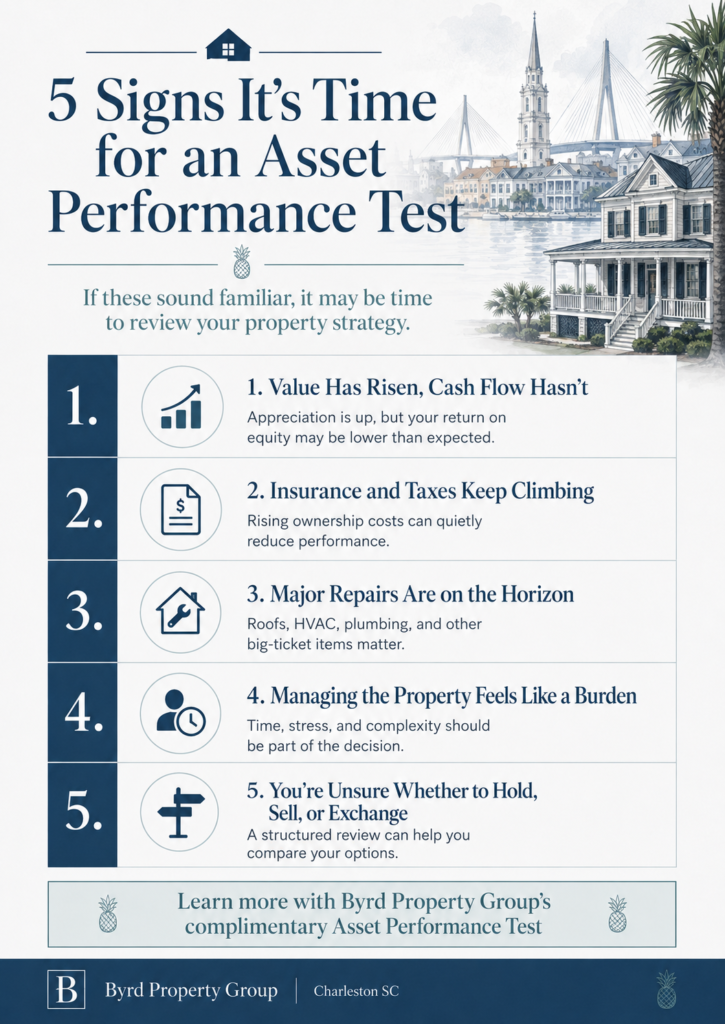
Where the Asset Performance Test Fits Inside the Investment Property Performance Review
The Asset Performance Test is one of the most important parts of the Investment Property Performance Review because it focuses on the property’s actual performance. It helps determine whether the property is still producing enough income, return, flexibility, and strategic value to justify the equity, risk, and responsibility tied to it.
1. Current Value vs. Current Income
Many Charleston investment properties have been excellent long-term investments. They may have appreciated substantially over time.
However, if the income has not kept pace with the property’s current value, your return on equity may be lower than expected.
That does not mean the property has been a bad investment. It may have been a great one.
But a property that once produced a strong return may now have a large amount of equity and only modest cash flow.
That does not automatically mean you should sell. It does mean you should review whether your equity could be working harder or creating more flexibility somewhere else.
2. Rising Operating Costs
Operating costs can quietly reduce performance.
Common pressure points include:
- Property insurance
- Flood insurance
- Property taxes
- HOA fees
- Maintenance costs
- Contractor pricing
- Pest control
- Landscaping
- Turnover expenses
- Property management fees
- Major systems nearing the end of useful life
A property can look profitable on the surface while producing less income after realistic costs are considered.
3. Deferred Maintenance
Older properties can create hidden risk.
A rental property may be producing income today, but if the roof, HVAC, exterior, plumbing, electrical systems, or drainage need major work soon, your actual return may be lower than it appears.
The Asset Performance Test helps identify whether upcoming capital expenses may change the hold, improve, sell, or exchange decision.
4. Tax Exposure
Long-held investment property can carry significant tax consequences if sold without planning.

Potential tax issues may include:
- Depreciation recapture
- Federal capital gains tax
- State capital gains tax
- Net Investment Income Tax for some higher-income sellers
This is why you should not evaluate a sale based only on the sales price. You need to understand the estimated result after debt, closing costs, taxes, and available planning strategies.
A 1031 exchange may be one option to consider if you want to sell investment property and reposition into other qualifying real estate. Before making that decision, you should review your options with your CPA, attorney, qualified intermediary, and real estate advisor.
5. Lifestyle and Management Burden
Sometimes the numbers are only part of the story.
A property may still be profitable, but it may also be creating stress, complexity, liability, or unwanted responsibility. That matters, especially if your priorities now include retirement planning, travel, family time, or simplifying your estate.
A smart real estate decision should consider both financial performance and personal impact.
Common Investment Property Performance Review Mistakes
Many property owners wait too long to review performance. They assume that because the property has gone up in value, it must still be a strong investment.
That is not always true.
Common mistakes include:
- Looking only at gross rent instead of net income
- Ignoring the value of the equity tied up in the property
- Underestimating future maintenance costs
- Forgetting to account for vacancy and turnover
- Waiting until a major repair forces a rushed decision
- Selling without understanding tax consequences
- Assuming heirs will want to manage the property
- Failing to explore 1031 exchange options before listing
- Reviewing the property without considering the owner’s current financial plan
- Not comparing multiple repositioning options before deciding to sell or hold
The best time to review your options is before you feel forced to act.
Local Investment Property Performance Review for Charleston Area Owners
Charleston real estate includes many different asset types. Each one may require a different strategy.
Examples include:
- A rental home on James Island or Johns Island
- A short-term rental in downtown Charleston, North Charleston or West Ashley
- A beach-area investment on Folly Beach, Edisto Beach, Kiawah or Seabrook Island, Sullivans Island or Isle of Palms
- A suburban rental in Summerville, N. Charleston or Mount Pleasant
- A vacant land parcel on Wadmalaw Island, Johns Island, Ravenel or Meggett
- An inherited family property anywhere in Charleston County, Dorchester or Berkeley Counties
- A long-held property anywhere in the Charleston area
The right decision depends on several local factors:
- Neighborhood demand
- Property condition
- Rental market strength
- Insurance exposure
- Flood zone considerations
- Future development trends
- Buyer demand for that property type
- Land use and zoning potential
- Current investor appetite
- Replacement property options
A Charleston-area review should also consider whether the current property type still fits the owner. A property that made sense during the accumulation years may not be the right property during retirement, estate planning, or income planning years.
This is why a local review matters. A generic online estimate cannot tell you whether your property is still aligned with your income, tax, retirement, and estate goals.
How to Prepare for an Investment Property Performance Review
If you own investment property in the Charleston SC area, you can start by gathering the basic information that affects performance.

1. Gather Your Property Information
Helpful details include:
- Current rent
- Lease terms
- Mortgage balance
- Property taxes
- Insurance costs
- HOA fees
- Recent repairs
- Property management expenses
- Vacancy history
2. Estimate Upcoming Capital Needs
Think about the age and condition of major systems:
- Roof
- HVAC
- Exterior siding or trim
- Windows
- Plumbing
- Electrical systems
- Drainage
- Driveways, docks, decks, or outbuildings
A property’s current income may look very different once future capital needs are considered.
3. Review Your Personal Goals
Ask yourself what you want this property to accomplish now.
Are you trying to:
- Increase income?
- Reduce active management?
- Prepare for retirement?
- Simplify your estate?
- Reposition equity?
- Reduce risk?
- Create more flexibility for your family?
Your goals matter as much as the numbers.
4. Understand Your Tax Picture
Talk with your CPA about basis, depreciation, capital gains exposure, and whether a 1031 exchange may be appropriate.
5. Review Your Bigger Financial Picture
Helpful items may include:
- Retirement income goals
- Estate planning concerns
- Family ownership issues
- Whether heirs would want the property
- Desire for active or passive ownership
- Interest in a 1031 exchange
- Need for more income, less management, or better diversification
6. Discuss Possible Repositioning Options
Before making a decision, consider whether the current equity could be repositioned into something that better supports your goals.
This conversation should happen before you list the property, not after you already have a contract.
Frequently Asked Questions: Investment Property Performance Review and the Asset Performance Test
An Investment Property Performance Review is a way to evaluate how well a property is performing compared to its current value, income, expenses, equity position, risk, and owner goals.
No. The Asset Performance Test is one important part of the Investment Property Performance Review. The Asset Performance Test focuses on how the property is performing. The broader Investment Property Performance Review also looks at valuation, rental income, cash flow, capital gains exposure, 1031 exchange opportunities, client goals, family needs, estate planning concerns, and future income needs.
No. A home valuation estimates what a property may sell for in the current market. An Asset Performance Test goes further by reviewing income, expenses, equity, return, future repair needs, tax considerations, and strategic options.
Yes. The review is designed to help you compare the current property against your goals, income needs, tax exposure, risk tolerance, estate plan, and possible alternatives.
Yes. If a 1031 exchange appears to be worth exploring, the review can help identify possible replacement property strategies based on your financial plan, family situation, estate goals, and desired level of management.
No. In many cases, the review may show that holding the property still makes sense. The goal is not to push a sale. The goal is to help the owner make a more informed decision.
Conclusion
Owning real estate in Charleston SC can be a powerful wealth-building tool. However, every investment property should be reviewed from time to time to make sure it still fits your financial goals, income needs, tax situation, estate plan, family priorities, and long-term plans.
An Investment Property Performance Review is the starting point for that conversation.
The Asset Performance Test is one important part of the review, but the bigger goal is to help you understand the full picture: what your property is worth, how it is performing, what tax exposure may exist, whether a 1031 exchange may help, and whether your equity could be better positioned for the next stage of life.
You may discover that your property is still worth holding. You may also discover that rising costs, lower return on equity, upcoming repairs, management burden, capital gains exposure, or new income needs make it worth exploring a different strategy.
Please feel free to request a complimentary Investment Property Performance Review from Byrd Property Group. We will help you evaluate your Charleston investment property with a calm, strategic, and practical approach.

About the Authors
Bill Byrd and Waverly Byrd serve clients throughout the Charleston area as Real Estate Wealth Advisors, helping individuals and families navigate complex property decisions connected to life transitions and long-term planning. Their work often involves, tax-advantaged 1031 exchanges, probate and estate property sales, divorce-related real estate solutions, trusts, and senior relocation, situations where informed coordination and careful timing can significantly impact outcomes.
With decades of experience, Bill and Waverly emphasize education, clarity, and collaboration. They regularly work alongside financial planners, tax professionals, and attorneys to help clients understand their options and align real estate decisions with broader financial and estate planning goals. As a father-and-daughter team, they guide clients through sensitive transactions with discretion, organization, and a steady, well-informed approach across the Lowcountry.