
Should I Sell My Rental Property or Keep It? A Charleston Owner’s Guide
How do you know if you should sell your rental property, or is it still worth holding?
A rental property may still be worth holding if the income, equity growth, tax benefits, and long-term goals outweigh the costs, repairs, risk, and management burden. Byrd Property Group’s Asset Performance Test helps Charleston SC property owners review those factors before deciding whether to hold, sell, exchange, or reposition their equity.

Introduction
You may have done everything right.
You made a good purchase years ago and you’ve held the property through some serious market changes. While you have managed tenants, repairs, insurance increases, rising taxes, and property management issues with ease, something feels different now?
The property may be worth more than ever, but it may not feel like it is working for you the way it once did. If that sounds familiar, you are not alone.
Many Charleston SC real estate investors eventually reach a point where they ask:
Should I sell my rental property, keep it, improve it, exchange it, or reposition the equity into something simpler?
That is exactly the kind of question Byrd Property Group’s Asset Performance Test is designed to help answer.
Why Long-Time Rental Property Owners Start Asking This Question
For many property owners, the question does not come up because the property failed.
It comes up because the property changed.
You may now be dealing with a very different ownership picture than you had when you first purchased it.
Common changes include:
- Property values have increased
- Rental income has not always kept pace
- Insurance costs have risen
- Property taxes are higher
- Maintenance and labor costs keep climbing
- Contractor quality and availability can be harder to manage
- Equipment replacement costs are higher
- Property management fees may cost more
- Landlord rules and legal responsibilities continue to change
- Estate and legacy planning may now matter more than before
The result is simple:
You may own a valuable asset that no longer makes as much financial or lifestyle sense to hold.
That does not automatically mean you should sell. It does mean the property deserves a fresh review.
Should I Sell My Rental Property?
A rental property can be worth keeping if it still supports your goals.
That means the decision should not be based only on appreciation or gross rent. A property can be worth more than ever and still produce a weaker return than expected.
Ask yourself:
- Is the property still producing strong net income?
- Are expenses reducing the real return?
- Is the equity working hard enough?
- Are major repairs coming soon?
- Is management becoming more difficult?
- Would I buy this same property today at its current value and current income?
- Does this property still fit my retirement, estate, and family goals?
That last question is important.
Many investors continue holding property because they have always owned it. But a property that made sense 10, 20, or 30 years ago may not automatically be the best fit today.
Your Rental Property’s Value Is Up, But Is Your Income?
This is one of the biggest issues long-time Charleston rental property owners face.
The property may have appreciated significantly. That is a good thing. However, if rental income has not increased at the same pace, your return on equity may be lower than you realize.
For example, a property that once produced a strong return may now have:
- High market value
- Significant equity
- Modest net income
- Rising expenses
- More management responsibility
- Future repair needs
That does not mean the property was a mistake. It may have been an excellent investment.
But a great investment from the past may not always be the best fit for your future.
This is why the question is not only: What is my property worth?
The better question is: How hard is my property working for me today?
Rising Expenses Can Change the Hold vs. Sell Decision
Many property owners focus first on rent. That is understandable.
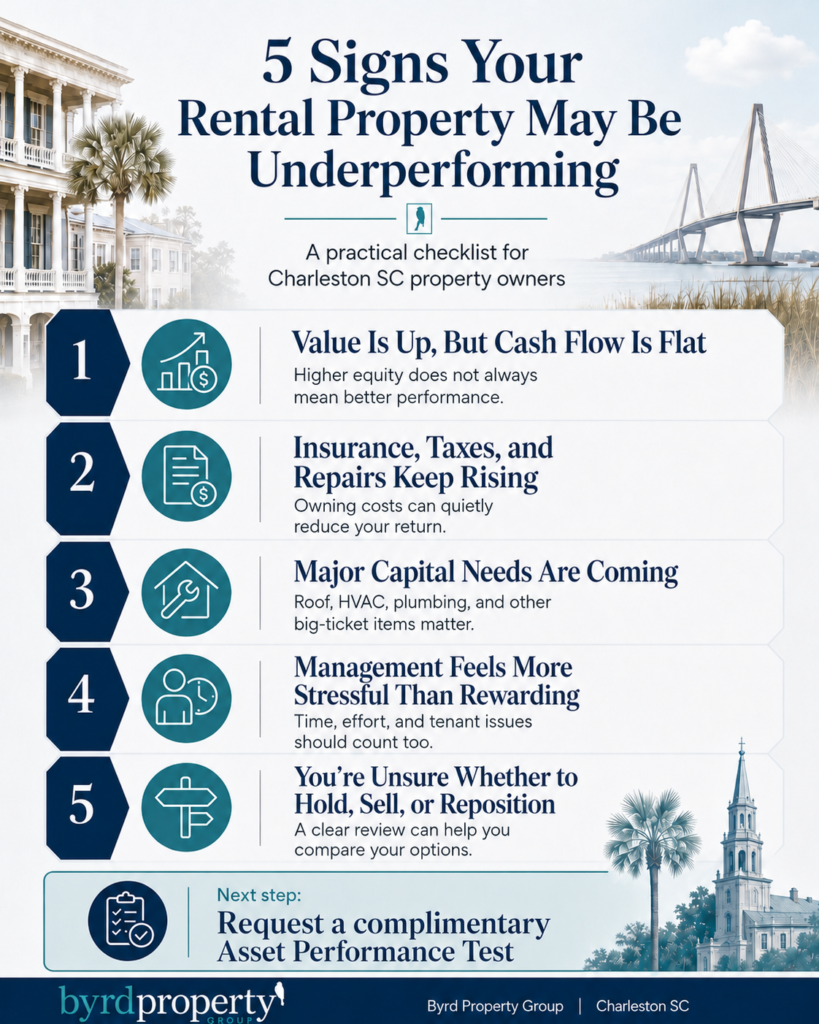
However, the better question is not just: How much rent am I collecting?
The better question is: How much am I really keeping after realistic costs, risk, repairs, and effort?
Common cost pressures include:
- Property insurance
- Flood insurance
- Property taxes
- HOA fees
- Repairs and maintenance
- Pest control
- Landscaping
- Property management fees
- Vacancy and turnover
- Appliance replacement
- Roof, HVAC, plumbing, and electrical updates
A property can look good on paper if you only look at gross rent. But once you factor in real ownership costs, the actual performance may be much lower than expected.
This is one or the many reasons an Asset Performance Test can be helpful. It allows you to look at the property as an asset, not just as a rental check.
When Management Burden Changes the Real Return
The numbers matter. But so does your time.
A rental property may still produce income, but if it creates constant stress, delays, repairs, tenant issues, or decision fatigue, the real return may not be as attractive as it appears.
This becomes especially important if you are moving toward retirement, simplifying your life, helping family members, traveling more, or thinking about estate planning.
Ask yourself:
- Do I still enjoy owning this property?
- Do I still want to deal with repairs and management issues?
- Is the income worth the time and stress?
- Would my family want to inherit and manage this property once I am gone?
- Is this property helping simplify my life or complicate it?
- Would I buy it again today at its current value with its current income?
A property’s performance is not only financial. It is also practical.
Should I Sell My Rental Property Before Major Repairs Are Needed?
This is a smart question to ask before repairs become urgent.
Older properties often need major capital improvements over time. Roofs, HVAC systems, plumbing, electrical systems, windows, drainage, siding, driveways, docks, and decks can all affect the true performance of a rental property.
A property may be producing positive income today. But if a large repair is likely in the near future, your real return may be weaker than it appears.
Before deciding whether to keep or sell, consider:
- What major systems may need replacement soon?
- Are upcoming repairs likely to improve income?
- Would the property need repairs before selling?
- Would repairs make the property easier to rent?
- Would the money spent on repairs create a strong return?
- Would another property or strategy better match your goals?
The goal is not to avoid repairs at all costs. The goal is to understand whether future repairs support your bigger plan.
Tax Exposure and 1031 Exchange Options Matter Before You Sell
Before you sell a long-held rental property, you should understand the possible tax consequences.
Potential tax issues may include:
- Depreciation recapture
- Federal capital gains tax
- State capital gains tax
- Net Investment Income Tax for some higher-income sellers
This is why you should not make the sell vs. hold decision based only on market value.
A 1031 exchange may be worth discussing if you want to sell investment property and reposition into other qualifying real estate. That conversation should happen before you list the property, not after you already have a contract.
Byrd Property Group does not provide tax or legal advice. However, an Asset Performance Test can help you identify better questions to discuss with your CPA, attorney, qualified intermediary, or financial advisor.
Estate and Legacy Planning Can Change the Decision
Long-held rental property often becomes part of a much larger planning conversation.
At some point, the question may shift from: Should I keep this rental property?
to: How does this property fit into my family, estate, tax, and legacy plan?
This matters because real estate is not always easy to divide, manage, or transfer.
For example:
- One heir may want the property while another does not
- Some heirs may live out of state
- The property may need repairs before it can be sold or rented
- Management may become harder over time
- A sale may create tax consequences
- A 1031 exchange may need to be considered before listing
- Repositioning the equity may make planning easier
These are not simple questions. They deserve a calm, thoughtful review before life forces a rushed decision.
Before You Sell Your Rental Property, Start With Clarity
When a rental property no longer feels like it is working the way it used to, many owners jump straight to one of two thoughts:
Maybe I should sell. Or: Maybe I should just keep it and deal with it later.
Well you can either be “Proactive” or “Reactive”!
Before you decide whether to hold, improve, sell, exchange, or simplify, it helps to review the property as an asset. That is why Byrd Property Group created the Asset Performance Test.
The Asset Performance Test is for “Proactive” real estate investors that are looking for a clearer picture of how your property is performing today, not how it performed when you first bought it.
How an Asset Performance Test Helps Charleston Real Estate Investors
The Asset Performance Test is a personalized review designed to help you understand your property’s current performance, ownership burden, and future options. It will definitly asnwer your question, should I sell my rental property?
It may help clarify:
- How much equity may be tied up in the property
- Whether the income still justifies the value
- Whether the property is underperforming or overperforming
- How rising costs affect performance
- Whether the management effort still matches the outcome
- Whether major repairs could change the decision
- Whether a 1031 exchange may be worth exploring
- How the property fits your retirement, estate, and family goals
- Whether holding, improving, selling, or repositioning deserves further discussion
The goal is not to pressure you into a decision. The goal is to help you see the property more clearly.
What This Is Not
Let’s be clear.
An Asset Performance Test is:
- Not a sales pitch
- Not a recommendation to sell
- Not tax advice
- Not legal advice
- Not a one-size-fits-all strategy
- Not a substitute for your CPA, attorney, or financial advisor
Think of it as a diagnostic review.
It gives you a starting point so you can have better conversations with your trusted advisors and make better real estate decisions.
Who Should Request an Asset Performance Test?
The Asset Performance Test may be helpful if you:
- Own one or more long-held rental properties
- Have owned investment real estate for many years
- Feel the workload has increased while returns have not
- Are tired of the management side of rental ownership
- Are thinking about retirement or simplification
- Want to understand your options before making changes
- Are concerned about taxes or capital gains
- Want to explore whether a 1031 exchange may apply
- Are thinking about estate or legacy planning
- Want clarity before your family is forced to deal with your property later
If you have ever thought, “I’ll deal with this later,” this may be the calm, logical place to start.
What Information Is Needed?
The Asset Performance Test starts with a few basic details.
You do not need to have everything perfect before beginning.
Helpful information includes:
- Property address
- Estimated current value
- Mortgage balance, if any
- Monthly rental income
- Lease terms
- Property taxes
- Insurance costs
- HOA fees, if any
- Property management costs
- Recent repairs or known upcoming repairs
- Basic ownership details
- Your general goals or concerns
The more complete the information, the more useful the review. But the process is designed to be simple and approachable.
What Happens After You Request an Asset Performance Test?
Once your information is reviewed, the next step is a simple conversation.
We can walk through:
- What the numbers suggest
- Where performance may be strong
- Where costs may be weakening the return
- How the property fits your goals
- What questions you may want to ask your CPA or attorney
- Whether holding, selling, exchanging, or repositioning your equity should be explored further
There is no pressure to make an immediate decision.
Many owners simply want to know where they stand. That clarity alone can be valuable.
Frequently Asked Questions
You should start by reviewing income, expenses, equity, repair needs, tax exposure, and management burden. If the property still supports your income, lifestyle, and long-term goals, holding may make sense. If not, selling, exchanging, improving, or repositioning may deserve a closer look.
A rental property may still be worth holding if the net income, future appreciation, tax benefits, and ownership effort still align with your goals. If rising costs, low cash flow, major repairs, or management stress outweigh the benefits, it may be time to review your options.
An underperforming rental property may still be valuable, but its income, expenses, equity, risk, and management effort may no longer align with your goals. The issue is not always property value. Sometimes the issue is whether the property is still producing enough benefit for the equity and effort required.
No. Many property owners request an Asset Performance Test simply to gain clarity. The review can help you understand whether your property still fits your current lifestyle, income needs, retirement plans, and long-term goals.
No. A property valuation estimates what the property may be worth in the current market. An Asset Performance Test goes further by reviewing income, expenses, equity, ownership effort, tax considerations, and possible next steps.
Yes. If your rental property no longer aligns with your goals, an Asset Performance Test can help you decide whether a 1031 exchange is worth discussing with your CPA, attorney, qualified intermediary, and real estate advisor.
No. The Asset Performance Test is an educational and planning tool. It is not tax, legal, or financial advice. It can help you identify better questions to discuss with your CPA, attorney, or financial advisor.
Conclusion
You may own an investment property that has appreciated greatly and yet it still deserves a fresh review.
That does not mean it was a bad investment. In fact, it may have been one of the best investments you ever made. But smart investors periodically review their properties to make sure those properties are still performing up to expectations.
Your Charleston rental property is worth more than ever and you have built significant equity, that is good news. However, the market can change. Expenses can change. Management can become harder. Your goals can change. And the return on your investment can evolve over time.
While many investors as the become “tired of dealing with rentals” ask themselves, is now the time, should I sell my rental property? Your “great investment” could now be underperforming, and you may not realize it! Maybe now is a great time to look more closely at it’s performance?
So before you decide whether to sell your rental property or keep it, start with clarity.
Byrd Property Group’s Asset Performance Test is designed to help you understand how your property is performing today and whether it still fits your income, lifestyle, tax, retirement, and estate planning goals.
Request your complimentary Asset Performance Test. We will help you review your Charleston real estate investment property with a calm, strategic, and practical approach.

About the Authors
Bill Byrd and Waverly Byrd serve clients throughout the Charleston area as Real Estate Wealth Advisors, helping individuals and families navigate complex property decisions connected to life transitions and long-term planning. Their work often involves, tax-advantaged 1031 exchanges, probate and estate property sales, divorce-related real estate solutions, trusts, and senior relocation, situations where informed coordination and careful timing can significantly impact outcomes.
With decades of experience, Bill and Waverly emphasize education, clarity, and collaboration. They regularly work alongside financial planners, tax professionals, and attorneys to help clients understand their options and align real estate decisions with broader financial and estate planning goals. As a father-and-daughter team, they guide clients through sensitive transactions with discretion, organization, and a steady, well-informed approach across the Lowcountry.